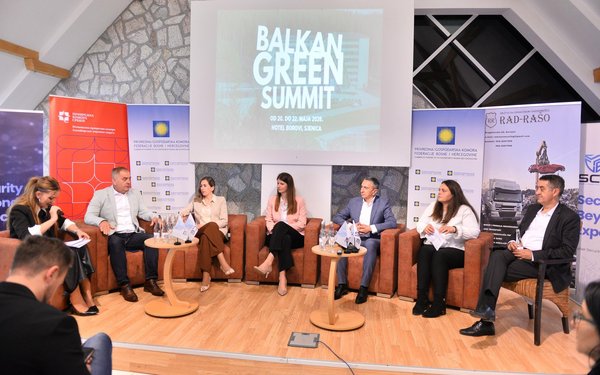
Last week, MACS attended the Balkan Green Summit organised by the Chamber of Commerce of the Federation of Bosnia and Herzegovina, which brought together representatives of governments, ministries, chambers of commerce, public institutions, utilities, local authorities, and private-sector companies from across the region.
The three-day summit focused on the implementation of the EU Green Agenda and sustainable development in the Western Balkans, covering topics such as Horizon Europe and IPA financing opportunities, CBAM, battery energy storage systems (BESS), prosumers, and the circular economy.
MACS participated in Panel V, “Sustainable Waste Management – Challenges of the Public and Private Sector”, held on the third day of the summit. During the panel, we presented the KfW Green Economy in Serbia programme which, in addition to financing energy efficiency and renewable energy projects, also provides financing opportunities for sustainable measures related to resource efficiency.
The discussion highlighted that both Bosnia and Herzegovina and Serbia continue to face significant challenges in the waste management sector, creating strong demand for investments in essential infrastructure such as transfer stations, recycling yards, and composting facilities.
The panel also provided an opportunity to exchange practical experiences between public utilities, waste management operators, and industry stakeholders, with discussions focusing on current operational challenges, project implementation, and future investment priorities across the sector.
A key takeaway from the summit was the growing regional focus on financing sustainable water and waste management, alongside circular economy initiatives, in addition to ongoing investments in energy efficiency and renewable energy. The discussions reflected a broader shift of the Green Agenda towards a wider range of sustainable development measures across the region.