In the context of MACS activities in developing Water Smart Network Optimization and our activities in the cooperation with our local daughter company MACS do Brasil and SISAR and the implementation of waterSmart in Brazil, our key Non-Revenue Water Expert Dr. Josep Pons and our Climate and Machine learning Expert Seyed Nima Hosseini have developed a second case study about water losses due to leakages in small rural water supply systems, based on the Data of SISAR Varzea da Cobra.
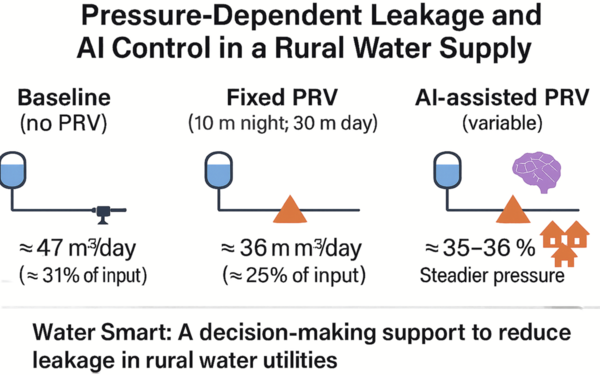
The study evaluates pressure management strategies in the Várzea da Cobra distribution network, located in northeastern Brazil, through a simulation-based approach. A hydraulic model incorporating pressure-dependent leakage was calibrated with Minimum Night Flow data to estimate real losses under local operating conditions. Three scenarios were analyzed: no pressure control, installation of a pressure reducing valve (PRV) with a fixed outlet setting and day/night modulation, and a dynamic PRV operated by an AI-assisted controller.
Results showed that the fixed PRV strategy reduced daily leakage by approximately 24% without compromising service levels. The AI-assisted PRV achieved comparable leakage reduction while maintaining more stable pressures throughout the day. To facilitate practical application, a Python-based decision-support tool was developed, enabling non-specialist operators to simulate and evaluate control strategies with minimal input data and Excel-based outputs. The findings demonstrate that effective pressure management, whether through simple mechanical solutions or advanced optimization, can significantly reduce leakage and improve reliability in rural water systems. This approach offers a scalable, low-cost pathway for enhancing water supply sustainability in developing regions.
Link to the full scientific Article: Pressure-dependent leakage modeling and AI-assisted control in a rural water supply network: Varzea da Cobra (Ceará, Brazil)